You Already Know What Good Looks Like — Now You Just Have to Catch Up to Yourself
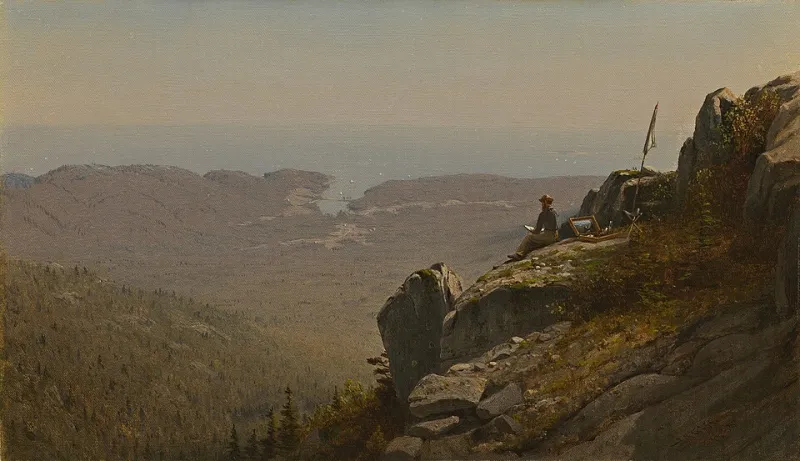
Photo: Sanford Robinson Gifford, Public domain, via Wikimedia Commons
There's a moment most creatives know well. You finish something — a logo, a painting, a layout, a photograph — and you sit back and feel this low, quiet hum of disappointment. Not because the work is bad, exactly. It's technically fine. But it doesn't match the version you had in your head. The one that felt clean and sharp and exactly right. The one that, somehow, your hands just couldn't pull off yet.
That gap has a name in some circles. Ira Glass famously called it the taste-skill divide. The idea is simple: your sense of quality develops faster than your technical ability to execute it. You start consuming great work, your standards climb, and then you sit down to make something and realize your output is still trailing behind your eye.
A lot of people treat this like a problem. I'd argue it's the closest thing to a superpower a developing creative can have.
Your Eye Got There First, and That's Not an Accident
Think about what it actually takes to recognize good work before you can make it. You have to be paying attention. You have to have internalized enough examples — enough typefaces, enough compositions, enough color relationships — that your brain has quietly built a framework for what resonates and what falls flat. That doesn't happen passively. It happens because you care.
Most people who pick up a camera or open Illustrator for the first time don't immediately feel that gap. They think what they made is pretty good because they don't yet have the references to know otherwise. The fact that you feel the gap means your taste is already working. Your internal standard exists and it's real. That's not a small thing.
The aesthetic debt — the distance between what you admire and what you can currently produce — is really just proof that you've been doing the right kind of looking.
The Compass You Didn't Know You Were Carrying
Here's the part that gets overlooked: taste is directional. It doesn't just tell you that something's off — it points toward what would make it right. When you look at your own work and feel that familiar drag of not quite, you're actually receiving pretty specific information. The spacing feels too tight. The palette is muddy. The composition is centered in a way that feels safe rather than considered.
That's not vague dissatisfaction. That's a critique. And a critique — even an internal one — is a roadmap.
The creatives who stall out aren't usually the ones with the taste gap. They're the ones who can't articulate what's wrong. They finish something, shrug, and move on without learning anything. When you can feel the distance between what you made and what you meant to make, you're already ahead of that. You know what direction to walk.
Sitting Inside the Discomfort Without Quitting
None of this makes the gap comfortable to live in. It's genuinely frustrating to have a vision you can see clearly and execution that keeps falling short. There's a reason so many people stop making work during this phase — it's the period when the feedback loop is most brutal and the rewards feel least proportionate to the effort.
But this is also where identity gets forged. The creatives who push through this window — who keep making work even when it disappoints them — are the ones who eventually close the gap. Not because the discomfort disappears, but because they get used to using it as fuel rather than a reason to stop.
One thing that helps: stop treating each piece as a final verdict on your ability and start treating it as a data point. Every project where you fall short of your own standard is a project that taught you something specific about where your skills need to develop. That's not failure — that's a curriculum you're writing for yourself in real time.
How Taste Shapes Voice Before You Even Realize It
Here's what's interesting about the long game. As your skills develop and start to close that gap, your taste doesn't stand still — it keeps evolving too. But the aesthetic sensibility you've been building all along, the framework of what you respond to and why, that becomes the foundation of your voice.
Your voice as a creative isn't just about what you can do technically. It's about what you consistently choose. Which problems you find interesting. Which solutions feel right to you even when other solutions would also work. That instinct — that set of preferences — is built exactly from the kind of active, critical looking that creates the taste gap in the first place.
In other words, the thing that's making you uncomfortable right now is the same thing that will eventually make your work recognizable. The gap is the origin story.
What to Do With It
If you're in the middle of this right now — making work that you can see is behind your own standard — a few things worth considering:
Keep the references close. Don't stop looking at work that's better than yours. Some people pull back from their influences when they're struggling, trying to avoid the comparison. That's the wrong move. Stay in contact with what you love. Let it keep calibrating your eye.
Name what's missing. When a piece doesn't land for you, try to put words on it. Not just "it's not working" but specifically what's off. The more precise you can get, the more useful the feedback becomes.
Make more, not less. Volume matters during this phase. Every piece is a rep. You're not going to close the gap by making fewer things and agonizing over each one — you're going to close it by working through problems repeatedly until your hands start to catch up with your head.
Give yourself the historical view. Pull up something you made a year ago. There's a decent chance you'll look at it and feel the gap between that work and where you are now. That gap already closed once. It'll close again.
The aesthetic debt isn't a flaw in your creative makeup. It's evidence that you've developed real standards — and that you're not willing to settle for work that doesn't meet them. That stubbornness, that refusal to call it good when it isn't, is exactly the thing that will drive you forward. It's not working against you. It never was.